Showing posts with label cooks alphabet. Show all posts

Thursday, 1 January 2009

Cook's Alphabet 'W'

Cook's Alphabet 'W'


This is the twenty-third in my series of 28 postings going through the entire alphabet, as it relates to cooks and cooking. As you can see, today I'm dealing with the letter 'W'.


The letter 'W' is, of course the twenty-third letter in the English alphabet and today's recipe is for a classic British w-themed cake from the 1950s:

West Indian Cake

Ingredients:
450g plain flour
225g butter
225g sugar
150ml milk
3 eggs
270g currants
115g mixed peel, chopped
1 tsp baking powder
freshly-grated zest of 1 lemon
1/2 tsp ground allspice
a little freshly-grated nutmeg

Method:
Sift together the flour, sugar, lemon zest, spices and baking powder in a bowl. Cube the butter and add to the flour mix then rub in with your fingers until the mixture resembles fine breadcrumbs.

Bring the milk to a boil and pour into the flour mixture. Stir to combine thoroughly then add the eggs one by one, beating well after each addition. Stir-in the currants and mixed peel then beat together lightly. Turn the batter into a buttered and floured cake tin and place in an oven pre-heated to 170°C. Bake for around 90 minutes, or until the top of the cake is golden and a skewer inserted into the centre emerges cleanly.

Allow the cake to cool for 5 minutes then transfer to a wire rack to cool completely


(This recipe reproduced, with permission, from the Celtnet West Indian Cake Recipe page, which is presented as part of the site's British recipes collection. )


Today's cooking term is Worcestershire Sauce: Worcestershire Sauce,is a classic British bottled sauce or condiment. that's said to have derived from an original Indian recipe. It is a widely used fermented liquid condiment originally manufactured by Lea & Perrins. The sauce itself ses malt vinegar (from barley), spirit vinegar, molasses, sugar, salt, anchovies, tamarind extract, onions, garlic, spices, and flavouring. This is an essential flavouring in many dishes as it imparts umami or fullnes in the mouth, due to the anchovies. It therefore gives dishes in which it's used an indefinable 'moreish' quality.

Worcestershire sauce is an essential ingredient in a Bloody Mary and in Hong Kong style dim sum, Worcestershire sauce is the de facto standard sauce for serving steamed beef meatballs. Once fermented the sauce is left to age in barrels, which concentrates the flavours. As a result only a dash is required in most meals.

Today's spice is Wasabi: Wasabi represents the pods of orchids in the genus Vanilla. Wasabi (also known as Japanese horseradish) is produced from the root of Wasabia japonica, a member of the Brassica family. The root itself has a very strong flavour and produces vapours that irritate the sinus cavity. As such, it is quite closely related to horseradish.

Wasabi is sold in root form, which must be very finely grated before use, or as a ready-to-use paste, which comes in tubes approximately the size and shape of travel toothpaste tubes. Once the paste is prepared it should remain covered until served to protect the flavor from evaporation. Wasabi is also available in powdered form, but because the active component is very volatile this is nowhere near as pungent as fresh wasabi. It should also be noted that many commercial preparations of 'wasabi' are actually a mix of horseradish, mustard and chlorophyll (used as a green colourant).


Below is a recipe for a classic Fusion dish of avocadoes and prawns served with a wasabi-flavoured dressing:


Avocado and Prawns in a Wasabi Dressing

Ingredients:
2 avocadoes, stoned and skinned
250g cooked, shelled, prawns
4 tsp light soy sauce
2 tbsp rice wine vinegar
2 tsp wasabi paste

Method:
Cut the avocado into 2cm cubes and the prawns into 2.5cm lengths. Place the prawns and avocados in a bowl, add the other ingredients together in a small bowl, whisk to mix then pour over the avocado and prawin mixture and toss to mix. Serve immediately to prevent the avocados from colouring.


(This recipe reproduced, with permission, from the Celtnet Avocado and Prawns in a Wasabi Dressing Recipe page. This is presented as part of the site's Fusion recipes collection. )


For more information on cookery-associated terms and information beginning with the letter 'W' here are various links that may well be of interest:

Recipes beginning with 'W'
Spices beginning with 'W'
Herbs beginning with 'W'
Wild foods beginning with 'W'
Cook's glossary 'W'

Wednesday, 31 December 2008

Cook's Alphabet 'V'

Cook's Alphabet 'V'


This is the twenty-second in my series of 28 postings going through the entire alphabet, as it relates to cooks and cooking. As you can see, today I'm dealing with the letter 'V'.


The letter 'V' is, of course the twenty-second letter in the English alphabet and stands for the meat, venison, around which today's recipe is based:

Venison Paprikash

Ingredients:
900g venison haunch cubed
2 tbsp bacon fat
1 onion, chopped
3 garlic cloves, chopped
1/2 tsp salt (or to taste)
1 tsp chilli flakes
3 tbsp paprika
250ml water
400g tinned, chopped, tomatoes, drained (reserve the juice)
2 tbsp plain flour
250ml sour cream
3 tbsp freshly-chopped parsley

Method:
Melt the bacon fat in a large pan or heat-proof casserole over medium heat and use to fry the onion, garlic, salt, chillies and paprika until the onions become translucent (about 6 minutes). Add the venison and fry for about 3 minutes per side and pour in the water. Stir to combine, bring to a boil then cover and reduce to a simmer.

Continue coking for about 80 minutes (adding more water as necessary), or until the pork is tender. Add the tomatoes and continue cooking. In the meanwhile, whisk the tomato juice, flour and sour cram to a smooth paste and slowly add this to the stew, stirring constantly. Continue cooking for about 20 minutes, or until the mixture is thick.

Transfer to a serving bowl, garnish with the parsley and serve accompanied by rice or noodles.


(This recipe reproduced, with permission, from the Celtnet Venison Paprikash Recipe page, which is presented as part of the site's British recipes collection. )


Today's cooking term is Verjus: Verjus, also known as verjuice (literally 'green juice') is a sour juice made from sour grapes, crab apples or other unripe fruit. It was used a great deal in medieval European cookery and is undergoing a revival. It's used as a flavouring in certain condiments, and in cooking can be used in place of lemon juice and vinegar. The term 'green' in the name refers to the uncooked nature of the juice rather than its colour (vinegar, in contrast, as it is soured by fermentation is considered to be 'cooked').

Today's spice is Vanilla: Vanilla represents the pods of orchids in the genus Vanilla. There are about 110 species in this genus, of which Vanilla planifolia is used to derive the spice. This is a vine growing to more than 35m in length, with alternate leaves spread along its length. The short, oblong, dark green leaves of the Vanilla are thick and leathery and each node produces long and strong aerial roots. Short-lived flowers arise successively on short peduncles from the leaf axils or scales. There may be up to 100 flowers on a single raceme, but usually no more than 20. The flowers are quite large and attractive with white, green, greenish yellow or cream colors. Each flower opens up in the morning and closes late in the afternoon, never to re-open. If pollinated, these mature to form the fruit (vanilla pod) which is an elongate, fleshy seed pod 10—20 cm long. It ripens gradually (8 to 9 months after flowering), eventually turning black in color and giving off a strong aroma. Each pod contains thousands of minute seeds, but it is the pod that is used to create commercial vanilla flavouring. Though most of the species in the genus Vanilla produce flavoursome pods, only Vanilla planifolia is used for industrial purposes.

As a spice vanilla comes either as the whole bean, vanilla powder or vanilla extract (this is an extract produced by dripping alchohol on split vanilla pods). Vanilla is highly fragrant with an exotic aroma. Vanilla is extensively used throughout the world in foods, confectionary, pharmaceuticals and beverages. Used almost exclusively in sweet cookery, vanilla is added to cakes, biscuits, puddings and desserts. However, in certain cuisines (Réunion cookery being notable) vanilla is used extensively in savoury dishes as well. Below is a recipe for a classic British dish of plums baked with vanilla:


Vanilla-baked Plum

Ingredients:
1kg flavoursome plums
3 vanilla pods, split and with seeds removed
1 glass vin santo
500g sugar

Method:
Arrange the plums in a roasting tray. Split the vanilla pods and scrape the seeds into the vin santo. Scatter the empty pods over the plums then stir the wine to make sure the vanilla seeds are evenly distributed before pouring over the plums. Scatter the sugar over the top, cover with greaseproof paper and then with a layer of aluminium foil (make certain to tuck this over the edges of the tray. Place in an oven pre-heated to 150°C for 45 minutes. Allow to cool a little before serving with cream or ice cream.


(This recipe reproduced, with permission, from the Celtnet Vanilla-baked Plum Recipe page. )


For more information on cookery-associated terms and information beginning with the letter 'V' here are various links that may well be of interest:

Recipes beginning with 'V'
Spices beginning with 'V'
Herbs beginning with 'V'
Wild foods beginning with 'V'
Cook's glossary 'V'

Monday, 29 December 2008

Cook's Alphabet 'U' — Um'bido (Peanut and Greens Stew) Recipe

Cook's Alphabet 'U'


This is the twenty-first in my series of 28 postings going through the entire alphabet, as it relates to cooks and cooking. As you can see, today I'm dealing with the letter 'U'.


The letter 'U' is, of course the twenty-first letter in the English alphabet and, apart from the letter 'X' it's the second most difficult recipes to get dishes named in. However, there are some classic dishes beginning with U (though the majority are African). Here I present Um'bido; a classic sauce common to much of sub-Saharan Africa made with peanuts and greens:

Um'bido (Peanut and Greens Stew) Recipe

Ingredients:
900g spinach
220g peanuts, coarsely ground
2 tbsp oil
1/2 tsp salt
1/4 tsp ground black pepper

Method:
Cook the spinach in just enough water to cover. After about 4 minutes sprinkle in the peanuts and stir-in well. Cover and continue to cook over medium heat for about 30 minutes, adding more water if necessary to prevent burning. Drain before serving and mix-in the oil, salt and pepper. My wife makes a variant of this: chilli um'bido that includes chillies.


(This recipe reproduced, with permission, from the Celtnet Um'bido Recipe page, which is presented as part of the site's African recipes collection. )


Today's cooking term is Umami: Umami is a Japanese word for one of the five basic tastes (along with the more familiar: sweet, sour, bitter and salty). Literally, Umami means 'savoury' or 'meaty' and refers to the 'full mouth' sensation produced by foods rich in gultamates, such as fish, meat, cheese and other protein-heavy foods. This is why monosodium glutamate (MSG) makes food taste 'better'. Anchovies are particularly rich in 'umami' and this is why the use of anchovy fillets and the use of anchovies in many sauces and condiments is so prevalent. It also probably explains the Roman predilection for fish sauce condiments which provided both salt and umami to the foods they were used to season.

Today's spice is Uzazi: Uzazi (is the Nigerian name for the spice derived from the pericarp and fruit of Zanthoxylum tessmannii. a West African member of the 'prickly ash' trees and a relative of Asian Sichuan Pepper and a member of the Rutaceae (citrus) family.

Z tessmanii has a more spicy flavour and even greater 'pungency' than Sichuan pepper and both the pericarp and inner fruit are ground and used as a flavouring in traditional West African 'pepper soups' (ie chilli-based stews). Below is a recipe for a classic West African cassava-based stew that incorporates uzazi as a spice:


Cassava Soup Recipe


Ingredients:
8–10 Scotch Bonnet chillies, made into a paste
1 kg lamb pieces on the bone, cubed
100ml strong beef stock (or 2 stock cubes in 100ml water)
1 tsp salt
1 tsp black pepper
1/4 tsp sumac (optional)
0.5kg cassava (peeled and cut into large chunks)
0.5kg yam (peeled and cut into large chunks)
3/4 kg sweet potato, peeled and cut into large chunks (red is best)
3 large plantains, peeled
3 onions, roughly chopped
3 ehuole seeds
6 uzazi peppercorns
3 large sardines, baked
2 dried fish fillets
3 tbsp red palm oil (optional)

Method:
Begin by pounding the uzazi and ehuole to a powder in a pestle and mortar. Add the chillies and pound to a paste then add 3 onions and pound those in.

Dry-fry the meat in a non-stick pan for a couple of minutes then add the remaining onion and the chilli paste, along with 1.5 l or water (including the stock). Bring the water to a boil then reduce to a simmer.

Meanwhile, soak the dried fish for about 20 minutes and prepare the sardines by removing the skin and bones and add the flesh to the broth. Strip the flesh from the dried fish as best you can and add this to the stew as well. Now add all the remaining ingredients to the stew (the cassava, yam and sweet potato should be cut in roast potato-sized chunks), bring back to the boil, reduce to a simmer and cook for 80 minutes, stirring occasionally.

At the end of this time add about 3 tbsp red palm oil


(This recipe reproduced, with permission, from the Celtnet Cassava Soup Recipe page. )


For more information on cookery-associated terms and information beginning with the letter 'U' here are various links that may well be of interest:

Recipes beginning with 'U'
Spices beginning with 'U'
Herbs beginning with 'U'
Wild foods beginning with 'U'
Cook's glossary 'U'

For more African Recipes, see the Celtnet Recipes Blog African Recipes page.


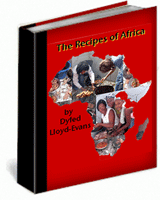
Recipes of Africa eBook
This list of African regions and African recipes is brought to you in association with the Recipes of Africa eBook. With over 1000 recipes covering each and every country in Africa, this is the most comprehensive book of African recipes available anywhere.

If you love African food, or are just interested in African cookery, then the Recipes of Africa eBook is a must-buy. You get information about every region of Africa and every African country along with a selection of classic and traditional recipes from that country.

This is a must-get book for anyone interested in food. Learn about a continent that to this day remains mysterious to many people. The recipes presented here are written by someone who has travelled extensively in Africa and who is a published Author. The book is a properly-produce and published eBook and the collection is immense.

Don't delay, get yourself a copy of the Recipes of Africa eBook today!

Saturday, 27 December 2008

Cook's Alphabet 'T'

Cook's Alphabet 'T'


This is the twentieth in my series of 28 postings going through the entire alphabet, as it relates to cooks and cooking. As you can see, today I'm dealing with the letter 'T'.


The letter 'T' is, of course the twentieth letter in the English alphabet, and today's recipe is for a classic Thai-inspired chicken salad (also a great way of using-up left-over Turkey:

Thai Chicken Salad

Ingredients:
6 chicken breasts, skinned
750g Romaine lettuce, shredded
1 bunch spring onions, white part only, cut into thin rings
80g red onion, diced
75g coriander leaves, shredded
100ml rice wine vinegar
juice of 1 lime
60m extra virgin olive oil
2 1/2 tbsl soy sauce
1/2 tbsp crushed chilli flakes

Method:
Pre-heat your grill and brush the chicken breasts with a little groundnut oil. Place on the grill rack and grill about 8cm from the heat source for about 4 minutes a side, or until the chicken breasts are completely cooked through.

Meanwhile, combine the lettuce, spring onions, red onion and the coriander in a large bowl. Combine the wine vinegar, olive oil, soy sauce, lime juice and chilli flakes and whisk to combine. Pour half over the salad mix and toss to combine.

Now slice the chicken at an angle. Plate-out the salad and arrange the sliced chicken breasts over the top. Drizzle with the remaining dressing and serve.


(This recipe reproduced, with permission, from the Celtnet Thai Chicken Salad Recipe page, which is presented as part of the site's South-east Asian recipes collection. )


Today's cooking term is Tagine: Tagine iis a meat and vegetable stew that stands at the core of Moroccan cuisine. The tagine is also the dish that the meal is cooked in. This is an earthenware dish with a conical-shaped lid that has a hole in the top. Tagines are cooked on a fire and the cooking ingredients are placed within and minimal liquid is used so that the resulting food is fairly dry. The conical shape of the lid is designed to act as a condenser so that little water is lost from the food by evapouaton — rather it condenses on the conical lid and drips back into the food.

Today's spice is Tasmanian Pepper Berry: Tasmanian Pepper Berry (also known as Mountain Pepper) is a native Australian spice that represents the dried fruit of the shrub, Tasmannia lanceolata which is part of the Winteraceae, a small family of shrubs from South East Asia and the Pacific Rim. The plant itself is mainly found on the Tasmanian Island, Australia; though it on the mainland in Victoria and New South Wales.

In Australia they are used as part of the growing trend for bush food where pepperberries are used to season emu burgers or kangaroo steaks. The berries are also crushed and mixed in vegetable oil before being used to marinate meat. In addition, the berries are used in flavored breads, pastas and patés, mustards and cheeses. In stews or sauces the pepperberries impart a vibrant red colour which can be very attractive.

Though largely known only in Australia Tasmanian Pepperberry is becoming available through a small number of on-line spice suppliers. Please note that if you are intrested in using this spice for your own cooking, then employ a light hand as they are ten times as hot as ordinary black pepper! The recipe below is for a traditional Australian pepperberry-flavoured dish:

Salmon with Acacia Seed and Tasmanian Pepper Berry Rub

Ingredients:
4 salmon fillets
2 tsp roasted acacia seeds, ground (substitute carob)
4 Tasmanian pepper berries (or use long pepper)
1 tsp coriander seeds, ground
1 tsp hot dried chillies, ground
1/2 tsp freshly-ground black pepper
1 tsp sea salt
6 tbsp flour
oil for frying

Method:
Combine all the spices together and mix into the flour. Dredge the fish in this then set aside to marinate for 10 minutes. Heal a little oil in a pan and when almost smoking dredge the fish in the flour once again and place in the pan. Fry on the sking side first and cook for 3 minutes then turn over and cook for 3 minutes on the other side until just done through. Serve immediately.

(This recipe reproduced, with permission, from the Celtnet Salmon with Acacia Seed and Tasmanian Pepper Berry Rub Recipe page. )


For more information on cookery-associated terms and information beginning with the letter 'T' here are various links that may well be of interest:

Recipes beginning with 'T'
Spices beginning with 'T'
Herbs beginning with 'T'
Wild foods beginning with 'T'
Cook's glossary 'T'
Related Posts Plugin for WordPress, Blogger...

Popular Posts