Saturday, 29 November 2008

Cook's Alphabet 'K' — Kufta Hoot (Libyan Fish Kofta)

Cook's Alphabet 'K'


This is the eleventh in my series of 28 postings going through the entire alphabet, as it relates to cooks and cooking. As you can see, today I'm dealing with the letter 'K'.


The letter 'K' is, of course the eleventh letter in the English alphabet, and today's recipe is for a classic Libyan dish of fish koftas:

Kufta Hoot (Libyan Fish Kofta) Recipe

Ingredients:
2 large white fish fillets (about 250g in all)
3 slices of bread, crumbed
1 tsp kammon hoot
1/2 bunch of coriander (cilantro), finely chopped
1 onion, grated
1 tsp chilli powder
2 garlic cloves, grated
1 tsp baking powder
2 eggs, beaten

For frying:
1 egg, beaten
2 tbsp water
flour for coating
oil for deep frying

Method:
Remove any pin bones and skin from the fish then chop as finely as you can (the finer the better). Add the fish to a bowl along with all the remaining ingredients and use your hands to mix all the ingredients thoroughly and to bring everything into a ball. Tear off pieces of the mixture in your hands and roll into sausage shapes.

Add oil to your deep fat fryer or to a depth of about 4cm in your wok then whisk together the egg and water in a bowl. Dip the fish koftas in this then roll in flour to coat. Place in the oil and deep fry until golden and cooked through (about 6 minutes). Transfer to a plate and serve with rice, salad and hot sauce

(This recipe reproduced, with permission, from the Celtnet Libyan Fish Kofta Recipe page, part of the site's Libyan recipes page. )


Today's cooking term is Knead: Kneading is the process of orking a dough either by hand (or thesedays with an electric dough hook). The process aerates and makes the gluten proteins more elastic and produces a smoother dough. It also evenly incorporates air and any additional ingredients at the same time. The main function is to release the gluten molecules from the grain. These produce cross-links in the dough that both stabilize the dough and incorporate air molecules, allowing it to rise evenly.


Today's spice is the Kokam: Kokam (also known as Mangosteen are the fruit of Garcinia indica, a tree native to tropics of the Old World. Though the whole fruit is used as a spice (especially in the Maharashtra region of India) it is far more common to encounter the dried peel which has an acid taste and an agreeable flavour and is used as a souring agent (often in place of Tamarind) in curries and other dishes from the Coorg region of India. Kokam soup, in Indian medicine is often made for its healing properties and the recipe is given below:

Kokam Soup

Ingredients:
9 dried kokum fruit (or 20 pieces of kokum rind)
2 tbsp ghee
900ml water
1 tbsp coriander leaves, chopped
4 curry leaves
1/2 tbsp cumin seeds
1/4 tsp ground cinnamon
4 whole cloves
2 tbsp chickpea flour
2 bay leaves
1/2 tsp salt
2 large pinches black pepper
1 tbsp palm sugar (or demarara sugar)

Method:

Soak the kokam fruit in 240ml of water for 20 minutes, ensuring that you squeeze the fruit (or rind) several times to extract as much flavour as possible. Discard the kokum when done.

Heat a dry frying pan and toast the cumin and cloves until they release their flavour. Transfer to a pestle and mortar or coffee grinder and reduce to a fine powder. Meanwhile heat a saucepan and add the ghee. Once the ghee is hot add the ground spices, curry leaves, coriander and bay leaves. Cook for a minute then add the fruit water and 300ml water. Mix the chickpea flour with the remaining 250ml of water then add this to the soup.

Stirring continuously to prevent lumps, add the black pepper, salt and palm sugar. Still stirring, boil gently for five minutes. Serve immediately.

(This recipe, reproduced with thanks, from the Celtnet Kokam Soup Recipe page.)


For more information on cookery-associated terms and information beginning with the letter 'K' here are various links that may well be of interest:

Recipes beginning with 'K'
Spices beginning with 'K'
Herbs beginning with 'K'
Wild foods beginning with 'K'
Cook's glossary 'K'


For more African Recipes, see the Celtnet Recipes Blog African Recipes page.
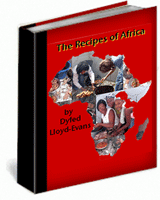

Recipes of Africa eBook
This list of African regions and African recipes is brought to you in association with the Recipes of Africa eBook. With over 1000 recipes covering each and every country in Africa, this is the most comprehensive book of African recipes available anywhere.

If you love African food, or are just interested in African cookery, then the Recipes of Africa eBook is a must-buy. You get information about every region of Africa and every African country along with a selection of classic and traditional recipes from that country.

This is a must-get book for anyone interested in food. Learn about a continent that to this day remains mysterious to many people. The recipes presented here are written by someone who has travelled extensively in Africa and who is a published Author. The book is a properly-produce and published eBook and the collection is immense.

Don't delay, get yourself a copy of the Recipes of Africa eBook today!

Thursday, 27 November 2008

Cook's Alphabet 'J'

Cook's Alphabet 'J'


This is the tenth in my series of 28 postings going through the entire alphabet, as it relates to cooks and cooking. As you can see, today I'm dealing with the letter 'J'.


The letter 'J' is, of course the tenth letter in the alphabet, and today's recipe is for a classic soup that uses a common and invasive weed, Japanese Knotweed:

Japanese Knotweed Soup

Ingredients:
1l vegetable stock
600g young Japanese knotweed shoots (or substitute rhubarb) sliced
250ml cream cheese

Method:
This is one of the simplest possible soups to prepare, just add the knotweed to the vegetable stock, simmer for 5 minutes then stir-in the cream cheese and serve.

(This recipe reproduced, with permission, from the Celtnet Japanes Knotweed Soup Recipe page. )


Today's cooking term is Julienne: Julienne is a French term that describes a classic way of cutting vegetables into thin matchsticks or very fine shreds, each about 4cm long. They're often cooked in butter in a covered pan until quite soft and then used as a garnish, especially for soups and consommés.


Today's spice is the Juniper Berry: Juniper Berries are actually the seed cones of the common juniper, Juniperus communis, a member of the cypress family. The cones, known commonly as 'juniper berries' are usually sold dried and used to flavour meats, sauces, and stuffings; most especially gam. They are generally crushed before use to release their flavour. These cones are also an essential ingredient in the flavouring of gin.


For more information on cookery-associated terms and information beginning with the letter 'I' here are various links that may well be of interest:

Recipes beginning with 'J'
Spices beginning with 'J'
Herbs beginning with 'J'
Wild foods beginning with 'J'
Cook's glossary 'J'

Wednesday, 26 November 2008

Cook's Alphabet 'I'

Cook's Alphabet 'I'


This is the ninth in my series of 28 postings going through the entire alphabet, as it relates to cooks and cooking. As you can see, today I'm dealing with the letter 'I'.


The letter 'I' is, of course the eighth letter in the alphabet, and today's recipe is for a classic Iced soup which is an Edwardian classic:

Iced Tomato and Basil Soup

Ingredients
450g tomatoes, chopped
1 small onion, chopped
1 tsp tomato purée
1 tsp finely shredded fresh basil
600ml chicken stock
salt and black pepper
2 tbsp fresh soured cream to garnish (optional)

Method:
Add the tomatoes, onion, tomato purée and basil to a blender and render to a smooth purée. Pass through a sieve to remove any seeds and large pieces of tomato skin then stir-in the stock. Transfer to a saucepan and heat gently. Skim-off any froth as it rises to the surface and season to taste.

Take off the heat after about 10 minutes, allow to cool to room temperature then chill in the refrigerator for at least 2 hours. Serve in lightly-chilled soup bowls, garnished with a swirl of soured cream (if desired).

(This recipe reproduced, with permission, from the Celtnet Iced Tomato and Basil Soup Recipe page. )


Today's cooking term is Infuse: Infusion is the process of extracting the flavours from herbs, spices, teas or vegetables by adding boiling water or by gently heating in a liquid like milk, thus allowing the liquid to take-on the flavours of the substance added to it.


Today's spice is Indian Mustard: Indian Mustard This is brown mustard, Brassica juncea), originally from the foothills of the Himalaya and is an essential ingredient in many Indian recipes and has a higher level of volatile mustard oils that white mustard (and is thus stronger, but not as strong as black mustard)..


For more information on cookery-associated terms and information beginning with the letter 'I' here are various links that may well be of interest:

Recipes beginning with 'I'
Spices beginning with 'I'
Herbs beginning with 'I'
Wild foods beginning with 'I'
Cook's glossary 'I'

Tuesday, 25 November 2008

Cook's Alphabet 'H'

Cook's Alphabet 'H'


This is the eighth in my series of 28 postings going through the entire alphabet, as it relates to cooks and cooking. As you can see, today I'm dealing with the letter 'H'.


The letter 'H' is, of course the eighth letter in the alphabet, and today's recipe is for a Medieval chicken recipe (or henne as they were called 700 years ago):

Henne in Bokenade (Chicken in Sauce)

1 whole chicken
fresh chicken broth (optional)
1 small bunch of parsley, chopped
2 tbsp chopped sage leaves
1 tbsp chopped hyssop
1 tsp mace
1 tsp cloves
1 dozen egg yolks, beaten
1 tbsp ginger
120ml verjuice (or red wine vinegar)
1/8 tsp saffron
1/8 tsp salt

Method:
Place the chicken in a large pot and add just enough water or fresh chicken broth to cover. Bring to a boil then reduce to a simmer and continue cooking until the meat is tender and falling from the bone.

Remove the chicken from the broth and allow to drain and cool. Pick the meat from the bones, discarding the fat and skin, and cut into large chunks. Place the meat in a separate large pot then strain the broth to discard all meat, fat, etc. Add just enough broth to the chicken in the pot to just cover the top of the meat. Then add the herbs a bring to a boil before reducing heat. Beat in the egg yolks, spices, and vinegar and simmer until thick.

(This recipe reproduced, with permission, from the Celtnet Ginger Cake Recipe page which is part of the Celtnet Medieval Recipes collection. )


Today's cooking term is Hard Crack Stage: Hard Crack Stage is a stage in the boiling of sugar, when the sugar reaches about 149–154°C and 99% sugar content by weight. At this stage the sugar will solidify into threads that will shatter at the slightest torsion (sideways pressure) when a drop of the sugar syrup is poured into water. This is the ideal stage for making toffee, nut brittles and lollipops.


Today's spice is Horseradish: Horseradish is a member of the brassicae (mustard or cabbage) family, which, like its relative, wasabi, has a root that has deposits of allyl isothiocyanate (mustard oil) within it. When the skin is broken it releases this mustard oil to irritate the sinuses of the nose and the eyes and it's this that makes horseradish an ideal condiment.


For more information on cookery-associated terms and information beginning with the letter 'H' here are various links that may well be of interest:

Recipes beginning with 'H'
Spices beginning with 'H'
Herbs beginning with 'H'
Wild foods beginning with 'H'
Cook's glossary 'H'

Sunday, 23 November 2008

Cook's Alphabet 'G'

Cook's Alphabet 'G'


This is the seventh in my series of 28 postings going through the entire alphabet, as it relates to cooks and cooking. As you can see, today I'm dealing with the letter 'G'.


The letter 'G' is, of course the seventh letter in the alphabet, and today's recipe is for a classic cake that includes a spice beginning with the letter 'G', ginger:

Ginger Cake

360g plain flour
180g butter
90g brown sugar
360g black treacle
60g sultanas
120g mixed peel
60g preserved ginger, finely chopped
1/2 tsp salt
2 tsp bicarbonate of soda
1 tsp ground ginger
3 eggs
3 tbsp milk

Sift together the flour, salt, bicarbonate of soda and ground ginger into a bowl. Add the sultanas, mixed peel and preserved ginger and stir to combine. Meanwhile add the treacle, butter and sugar to a pan heat gently until the butter melts and the treacle becomes liquid. Beat together the eggs and milk, add to the treacle mix and take off the heat. Stir to combine then make a well in the flour and pour the treacle mix into this.

Beat thoroughly to combine then turn into a 18cm square cake tin that's been lightly greased and lined with greaseproof paper. Transfer to an oven pre-heated to 160°C and bake for 75 minutes, or until the top is coloured and the cake is firm to the touch. Allow to cool in the tin for 10 minutes then turn out onto a wire rack and allow to cool completely. Store in an air-tight tin..

(This recipe reproduced, with permission, from the Celtnet Ginger Cake Recipe page. )


Today's cooking term is Gram Flour: Gram Flour is a traditional Indian flour made by grinding chickpeas to a flour. It is very fine and a pale yellow in colour and is a critical component in making samosas and bhajis.


For more information on cookery-associated terms and information beginning with the letter 'G' here are various links that may well be of interest:

Recipes beginning with 'G'
Spices beginning with 'G'
Herbs beginning with 'G'
Wild foods beginning with 'G'
Cook's glossary 'G'

Saturday, 22 November 2008

Cook's Alphabet 'F'

Cook's Alphabet 'F'


This is the sixth in my series of 28 postings going through the entire alphabet, as it relates to cooks and cooking. As you can see, today I'm dealing with the letter 'F'.


The letter 'F' is, of course the sixth letter in the alphabet, and today's recipe is for a classic Italian bread, Focaccia:

Focaccia with Roesmary Leaves and Olives

7g (1/2 packet) dry yeast
120ml lukewarm water
1 tsp sugar
180g plain flour
1 tbsp extra virgin olive oil
1/2 tsp salt
120ml cup cold water
1 tsp sea salt
1 tbsp fresh rosemary leaves
80g black olives, pitted

Sprinkle the yeast and sugar over the warm water and stir well then set aside for some 15 minutes, until it is foamy on top. Meanwhile place the flour in a large bowl and make a well in the middle. Gradually stir in the yeast mixture and then the olive oil, salt and water, stirring all the while to form a stiff dough. Lightly flour your hands and knead the dough in the bowl for a minute before turning it out onto a floured board. Knead for about 15 minutes, until you have a silky dough then place in an oiled bowl and cover. Leave in a warm place for about an hour, or until doubled in size.

Gently knock the dough back and then place on an oiled baking tray before stretching the dough into a rectangular shape and using the tips of your fingers make indents in the surface of the dough. Brush with oil, sprinkle with sea salt, rosemary and olives. Then place in an oven pre-heated to 200°C and bake for about 20 minutes, until crisp and golden.

(This recipe reproduced, with permission, from the Celtnet Focaccia with Roesmary Leaves and Olives Recipe page. Which is part of the site's Italian Recipes collection)


Today's cooking term is Fricassée: Fricassée is a dish of chicken or vegetables cooked (usually on the stove-top) in a creamy white sauce. Often vermouth is added as a flavouring and the dish is traditionally served with rice. The dish is often accompanied by lightly-glazed onions and/or fried mushrooms.


For more information on cookery-associated terms and information beginning with the letter 'F' here are various links that may well be of interest:

Recipes beginning with 'F'
Spices beginning with 'F'
Herbs beginning with 'F'
Wild foods beginning with 'F'
Cook's glossary 'F'

Friday, 21 November 2008

Cook's Alphabet 'E'

Cook's Alphabet 'E'


This is the fifth in my series of 28 postings going through the entire alphabet, as it relates to cooks and cooking. As you can see, today I'm dealing with the letter 'E'.


The letter 'E' is, of course the fifth letter in the alphabet, and today's recipe is for a classic British wild food sorbet that both begins with the letter 'E' and which contains elderberries, a wild 'E' fruit as a main ingredient:

Elderberry Sorbet

775g elderberries, removed from the sprays with a fork
100g caster sugar
juice of 1/2 lemon
1 tbsp egg white

Add the sugar to a pan along with 120ml water. Heat gently until the sugar dissolves then bring to a boil and immediately take off the heat then set aside to cool. Meanwhile, use the tines of a fork to remove the elderberries from their stalks. Add the elderberries and lemon juice to a food processor. Process to a smooth purée then strain through a fine-meshed sieve to remove any seeds.

Once the sugar solution is cold mix with the fruit purée. Pour the resultant mixture into the bowl of an ice cream machine and churn according to the manufacturer's instructions.

Alternatively, if you don't have an ice cream making machine, pour the mixture into a non-metallic freezer-proof dish then cover with a lid and place in the freezer. Freeze until the sorbet is almost firm (but still a little liquid). Cut the sorbet into chunks and place in a blender. Process until smooth then add the egg white and continue processing until completely blended. Transfer the sorbet back into the dish and freeze again until almost firm.

Once again chop the sorbet into pieces and process until smooth. This gets rid of all the ice crystals and makes the sorbet very smooth, which is what you want. Return to the freezer-proof dish and freeze completely. To serve, allow the sorbet to soften for 5 to 10 minutes at room temperature then spoon into dessert glasses and serve, garnished with a sprig of fresh mint.

(This recipe reproduced, with permission, from the Celtnet Elderberry Sorbet Recipe page. Which is part of the site's Wild Food Recipes collection)


Today's cooking process is Emulsion: Emulsion is a stable suspension of oil and water (think of paint). In cookery this is a combination of fat and water with a stabilizing agent (usually eggs). Good examples are mayonnaise or Hollandaise sauce.


For more information on cookery-associated terms and information beginning with the letter 'E' here are various links that may well be of interest:

Recipes beginning with 'E'
Spices beginning with 'E'
Herbs beginning with 'E'
Wild foods beginning with 'E'
Cook's glossary 'E'
Related Posts Plugin for WordPress, Blogger...

Popular Posts