Saturday, 6 August 2011

Greens, Beef and Peanut Stew From Madagascar

Today's recipe is a classic stew of greens, beef and peanuts form the island of Madagascar:

Greens with Peanuts and Minced Beef Recipe


Ingredients:
1.5kg kale or cabbage leaves (use savoy cabbage)
1 tbsp salt
2 medium onions
500g minced beef
400g tinned, chopped, tomatoes (with juice)
1 tbsp oil
1/4 tsp curry powder (or to taste)
1/4 tsp freshly-ground black pepper (or to taste)
120g raw peanuts

Method:
Place the kale (or cabbage) leaves and salt in a pan. Cover with water, bring to a boil and cook for about 2 hours until they are no longer bitter and have reduced to the consistency of a paste (add more water as needed and stir frequently).

In a separate pan, fry the onion in the oil for about 5 minutes, or until soft and translucent. Add the tomatoes and cook for about 8 minutes, or until the tomatoes begin to break down. Stir in the beat, breaking any large clumps as you do so. Cook for about 10 minutes, or until the meat is done through. Now stir in the curry powder and black pepper then cover the pan and take off the heat then stir in the peanuts.

When the greens have cooked, make the liquid in the pan with them up to 500ml (either add or remove liquid). Stir in the beef and peanut mixture and bring to a simmer. Cook over medium heat for about 20 minutes, or until the peanuts are al dente and the sauce is thick and reduced.

Adjust the seasonings to taste and serve hot on a bed of rice.

On the Celtnet recipes site you can find more classic recipes from Madagascar, as well as thousands of beef-based recipes and many hundreds of greens-based recipes.

For more African Recipes, see the Celtnet Recipes Blog African Recipes page.
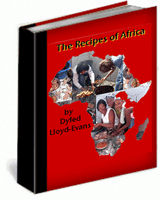

Recipes of Africa eBook
This list of African regions and African recipes is brought to you in association with the Recipes of Africa eBook. With over 1000 recipes covering each and every country in Africa, this is the most comprehensive book of African recipes available anywhere.

If you love African food, or are just interested in African cookery, then the Recipes of Africa eBook is a must-buy. You get information about every region of Africa and every African country along with a selection of classic and traditional recipes from that country.

This is a must-get book for anyone interested in food. Learn about a continent that to this day remains mysterious to many people. The recipes presented here are written by someone who has travelled extensively in Africa and who is a published Author. The book is a properly-produce and published eBook and the collection is immense.

Don't delay, get yourself a copy of the Recipes of Africa eBook today!

Wednesday, 3 August 2011

Classic Senegalese Fish Recipes (Sea Bream Stuffed with Peanuts)

With an extensive Atlantic coastline, Senegal in West Africa has a long tradition of fishing and the preparation of fish-based dishes.

This is a classic recipe from Senegal for sea bream stuffed with peanuts and chillies that's cooked in a coconut milk base.


Sea Bream Stuffed with Peanuts Recipe


Ingredients:

1 large sea bream
300g fresh peanuts
2 slices of white bread, crusts removed
100ml coconut milk
1 tbsp tomato purée
1 hot chilli, finely chopped
salt and freshly-ground black pepper, to taste
juice of 1 lemon

Method:
Scale and clean the fish then wash thoroughly and set aside.

Soak the bread in the coconut milk then squeeze out any excess and crumble into a bowl. Grind the peanuts as finely as you can and add to the bowl along with the tomato purée and chopped chilli. Season with salt and black pepper to taste and stir to combine.

Season the fish liberally inside and out with salt. Use the stuffing to fill the body cavity of the fish then sew it closed. Set the fish in an oven-proof dish and drizzle over the lemon juice. Transfer to an oven pre-heated to 180°C and bake for 40 minutes, basting frequently with the pan juices.

Serve hot, accompanied by white rice.

For more classic Senegalese recipes, see the Senegalese recipes page part of the Celtnet West African recipes site.

For more African Recipes, see the Celtnet Recipes Blog African Recipes page.


Recipes of Africa eBook
This list of African regions and African recipes is brought to you in association with the Recipes of Africa eBook. With over 1000 recipes covering each and every country in Africa, this is the most comprehensive book of African recipes available anywhere.

If you love African food, or are just interested in African cookery, then the Recipes of Africa eBook is a must-buy. You get information about every region of Africa and every African country along with a selection of classic and traditional recipes from that country.

This is a must-get book for anyone interested in food. Learn about a continent that to this day remains mysterious to many people. The recipes presented here are written by someone who has travelled extensively in Africa and who is a published Author. The book is a properly-produce and published eBook and the collection is immense.

Don't delay, get yourself a copy of the Recipes of Africa eBook today!

Wednesday, 27 July 2011

Wild Food Guide 'P'

Wild Foods Guide 'P'


This is the sixteenth of my series of 26 postings on wild foods. Each post will deal with a separate letter of the alphabet ('P' today) and will describe a wild food beginning with that letter as well as presenting a classic recipe incorporating that wild food.

Today I'm dealing with the letter 'P', the sixteenth letter of the English alphabet, which includes foods such as Pellitory, Pennywort, Purple Laver, Parasol Mushroom, Penny Buns (Ceps), Pepper dulse, Petalonia, Poppy, Promrose, Purple Salsify, Purslane, and many others and many others. Today, however I am going to devote this page to Pepper Dulse and Parasol Mushrooms.


The Pepper Dulse Osmundea pinnatifida is a small red seaweed that grows profusely on exposed to moderately sheltered rocky shores and is common to the middle and lower rocky shores, often covering large areas with a greenish-yellow turf like growth in pools and on rocks. It typically grows up to 8cm in length which is tough and cartilaginous with flattened fronds. Branching is alternate and occurs in one plane only, with branches becoming shorter towards their apex and broadly rounded.

The seaweed is highly aromatic and though the its tough nature tends to make it unpopular as a direclty useful edible species it can be used in small quantities, if shredded, to flavour stir-fires where it imparts an interesting peppery taste. Indeed, it used to be collected in large quantities in Scotland where it was dried and used as a pepper substitute.

Below is a classic Scottish recipe for a Scotch Broth variant that's flavoured with dried pepper dulse:

Scotch Broth with Pepper Dulse

Ingredients:
1kg scrag end of lamb or neck fillet
50g washed pearl barley
3 medium carrots, cubed
2 medium onions, cubed
2 medium potatoes, cubed
1 swede, cubed
200g baby turnips, cubed
3 leeks, shredded
1 small head of cabbage, shredded
1 sprig thyme (wild thyme in the original)
2 tbsp dried pepper dulse, ground, to season
sea salt, to taste

Method:
Trim any excess fat from the meat, then place in a large heavy-bottomed pot and cover with water. Bring to the boil and begin skimming any fat the raises to the top. Once the surface is clear replace any lost water, bring back to the boil, then reduce to a simmer and add the pearly barley. Add the vegetables, thyme and pepper dulse and cook for a further two hours. The broth can be served immediately, but actually tastes much better the following day. At this point you can add fresh greens such as peas, french beans, new potatoes, broad beans etc. Cook for 20 minutes then adjust the seasonings to taste and serve.

This recipe is reproduced, with permission, from the Scotch Broth with Pepper Dulse Recipe from the Celtnet Guide to Edible Seaweeds collection.


Parasol Mushroom Macrolepiota procera, is a fairly common parasol-shaped mushroom typically found on well-drained soils that fruits from August to November and often forms fairy rings.

This is a very large mushroom that resembles a woman's parasol (hence the name). The cap is never less than 8cm in diameter and may reach up to 40cm. They are also ideal for drying and re-constitiute in water particularly well and they have a pleasant, nutty aroma. They are a very sought-after edible mushroom and the firm texture makes them ideal for a wide range of culinary uses. They are also good eaten raw.

Care should be taken, however, not to confuse smaller specimens of Parasol Mushrooms with the Shaggy Parasol mushroom.

The recipe presented below is for a classic starter of Parasol Mushroom fritters.

Parasol Mushroom Fritters

Ingredients:
4 large, open capped, Parasol Mushrooms
50g plain flour
1 egg
125ml milk
pinch of salt
1 tsp mixed fresh herbs, chopped
black pepper, to taste
2 tbsp butter, melted
oil for deep frying

Method:
Wipe the mushrooms clean, remove the stems then cut into quarters and set aside.

Beat the egg and milk together until smooth then add the flour and beat to a smooth paste. Season and add the butter and black pepper.

Dust the mushrooms with flour then dip in the batter and immediately deep fry in hot oil (at least 180°C) cook until nicely browned then drain on kitchen paper and serve.

This recipe is reproduced, with permission, from the Parasol Fritters Recipe from the Celtnet Guide to Edible Mushroms and Fungi.

This guide is brought to you in conjunction with the Celtnet Wild Food Recipes collection.

You can find more wild foods beginning with the letter 'P' on the Wild Food Guide for the letter 'P', part of the Celtnet Wild Food Guide.

Friday, 22 July 2011

Vegetable and Chocolate Loaf

With young root vegetables just starting to come into season (and being at their sweetest), today I am posting a rather unusual, but delicious, recipe to use these vegetables.

There is a long tradition of using sweet root vegetables to prepare sweet cakes and pies. They marry well with sugar and with chocolate and give you a moist cake with considerable lasting power.


Beetroot is one of my favourites, as it gives an intense colour (the recipe below is for a Beetroot and Chocolate Loaf, but carrots and sweet potatoes also work well.

Beetroot and Chocolate Loaf

Ingredients:

240g self-raising flour
30g cocoa powder
1 tsp baking powder
120g caster sugar
pinch of salt
90g dark chocolate (at least 80% cocoa solids), melted
90g butter, melted

120g beetroot, peeled an grated (raw is the best, but whole, pickled, baby beetroot can be used)
2 eggs, beaten

Instructions:

Sift together the flour, cocoa powder, baking powder and salt into a bowl. Meanwhile place the chocolate and butter in a bowl and set over a pan of lightly simmering water to melt. When melted stir to combine then add the sugar and grated sweet potatoes. Lightly whisk the eggs and add the chocolate mix to this. Stir the egg and chocolate mixture into the dry ingredients until you have a smooth batter then turn into a well-greased 1kg loaf tin.


Place in an oven pre-heated to 180°C and bake for about 50 minutes, or until firm to the touch and a skewer inserted into the centre of the cake emerges cleanly. Allow to cool for 10 minutes in the tin then tip onto a wire rack and allow to cool completely.

If you have enjoyed this recipe, then you can find more traditional and modern cake recipes here.

Monday, 11 July 2011

The Demise (and Rise) of British Truffles


British Truffles


It's little known today, but the rather unassuming British Summer truffle, Tuber aestivum was once the centre of a major industry.


This is a black truffle, about the size of a squash ball that's native to Europe. Though it's not as strongly flavoured as the more famous Perigord truffle, it is still flavoursome and is widely hunted for in France and Italy. Indeed, during the Victorian period it was much gathered and during its fruiting period (May to August in the UK) it was much gathered and hundreds of kg were collected for sale in major markets.

This is why Victorian chefs such as Charles Elmé Francatelli were so liberal in the use of truffles in their recipes. An example of this being Francatelli's recipe for d'Uxelles Sauce:


No. 75.—D'UXELLES SAUCE.


Chop fine the following ingredients in equal proportions, according to the quality of sauce required for present use: viz.—mushrooms, truffles, ham, parsley, and shalots; put these into a small stewpan with an ounce of scraped fat bacon, and stir the whole over the fire for six minutes; then add about half a pint of sauce, the juice of half a lemon, nutmeg, pepper, and salt, a good pinch of sugar, and four yolks of eggs; stir again over the fire to set the eggs, and use the d'Uxelles as herein directed.

Blow is a Modern Redaction of this recipe:

Francatelli's d'Uxelles Sauce

Ingredients:
60g mushrooms, finely chopped
2 truffles, finely chopped
60g ham, finely chopped
4 tbsp parsley, finely chopped
60g shallots, finely chopped
45g bacon fat
300ml brown sauce
juice of 1/2 lemon
generous pinch of sugar
salt, freshly-ground black pepper and freshly-grated nutmeg, to taste
4 egg yolks

Method:

Melt the bacon in a pan, add the mushrooms, ham, parsley and shallots. Fry gently for about six minutes, or until lightly browned then add the sauce, lemon juice, sugar and seasonings. Bring to a simmer then take off the heat.

Beat the egg yolks in a bowl and, whilst whisking constantly, add the add about a ladle of the sauce to temper the eggs. Pour the tempered egg mix back into the pan and whisk to combine. Set over low heat and continue to cook until thickened. Take off the heat and serve immediately.

Over 60 years ago, the British truffle industry died out and interest in British truffles withered away. However, with summer truffles retailing for £120 per kg there is now renewed interest in this fungus and truffle hunting dogs are being imported from Perigord and Italy to hunt these black gems.

Indeed, recent dry summers seem to have been beneficial for Summer Truffles and some dedicuous forests (those with alkaline soils on a bed of chalk and a preponderance of beech) are generating hundreds of kilograms of these fungi, generating renewed interest in these native culinary delights.


If you would like more information about edible mushrooms, then check out the Celtnet Edible Mushroom Guide.

For all the wild food recipes on this blog, see the wild food recipes page.


UPDATE! The complete text of Francatelli's Cook's Guide has been edited and published!

This recipe and over 1000 other recipes published in Francatelli's 1661 'The Cook's Guide and Housekeeper's and Butler's Assistant' has been published in eBook format. The complete text and all images from Francatelli's book has been re-edited and made available with an introduction and new biography. You also get essential Victorian recipes for basic pastries and store sauces that are needed to re-create Francatelli's recipes but which Francatelli himself did not publish.

In addition over 100 of Francatelli's recipes, including all the Reform Club recipes have been redacted and published as a separate chapter so that a modern cook can copy them. Using these recipes and the additional Victorian recipes provided you can re-create all of Francatelli's dishes from scratch.

So why not re-create a Victorian dinner party, or a Victorian Christmas meal as described by Francatelli himself in his Bills of Fare? Learn why Francatelli is one of the most well respected of the Victorian cookery writers and get a copy of his book for yourself today.

Wednesday, 29 June 2011

Classic Mother Sauces

Preparing Classic Sauces


From the Roman cookery of Apicius sauces of one kind or another have been an integral art of European cookery. These evolved into the Middle ages, and from sources such as the Forme of Cury and its French and Italian equivalents we can see the development of modern cookery.

These developed into what the French term 'mother sauces' base sauces from which other sauces can be derived. Of course, one of the true base sauces is French Béchamel sauce, and the recipe below is derived from Mrs Beeton:

Béchaeml Sauce


Ingredients


1 small bunch of parsley
2 cloves
1/2 bayleaf
1 small bunch of savoury herbs (tied together)
salt, to taste
4 mushrooms
1.2l white stock
600ml cream
1 tbsp arrowroot

Method:
Combine the stock, parsley, cloves, bayleaf, herbs and mushrooms in a pan. Season with salt (but do not add pepper) then bring to a boil and cook for about 5 minutes (or until the flavour has been drawn from the herbs) then strain and return the liquid to the pan.

Bring back to a boil and cook until the volume has reduced by half (about 20 minutes). Whisk the arrowroot into the cream until smooth then pour the mixture into a clean pan, bring to a simmer and cook for 5 minutes over low heat.

Whisk the cream mixture into the stock mixture and simmer slowly for 10 minutes, or until the sauce is thick. This is a classic base sauce which can be thinned with milk to make a pouring sauce, if desired.

This can be converted into a range of other sauces, such as Aurore sauce (just add tomato purée).


Another classic base or mother sauce is Sauce Tournée, again from Mrs Beeton:

Sauce Tournée


Ingredients

600ml white stock
1 tbsp butter mixed to a smooth paste with 1 tbsp plain flour (or white roux)
1 bunch of savoury herbs, tied together (must include parsley)
6 mushrooms, chopped
6 shallots

Method:

Combine the stock, herbs, onions and mushrooms in a pan. Bring to a simmer and cook gently for about 30 minutes. Now whisk in enough of the thickening to bring the mixture together as a sauce.

Bring to a boil and cook for a few minutes. Skim the surface, strain and serve immediately.

This is a base sauce for Allemande Sauce, Mussel sauce and a range of others.


By learning to prepare a few basic sauces, you can give all your recipes a lift by using variants of those sauces to dress your dishes.


For many more sauce recipes (basic sauces and derivatives), visit the Celtnet Recipes for Sauces Home page where you will see hundreds of sauce recipes from across the globe.

Enjoy!

Saturday, 21 May 2011

Medieval Cookery

Forme of Cury Recipes and Translations

I love cooking and I love the history of cookery. The problem is, that for early cooking we are left with a small number of sources... Apicius being the earliest (about 400 AD) then we have the beginnings of medieval cookery writing in the 14th Century.

One of the earliest of these cookery books is the Forme of Cury, a cookery book, written at the behest of Richard II of England, about 1390. This is notable for being the first cookery book written in English and for being one of the first books written in the newly emergent language of English itself.

For the first time, the Celtnet website has made the entire text of The Forme of Cury freely available on the web. If you navigate to the Forme of Cury Contents Page you will see the entire recipe list from the book with links to each recipe. Click on these links and you will be taken through to a facsimile version of that recipe with a side-by-side version in English.

The recipes are rendered with a special font so that, in modern browsers they appear as close to the original handwritten manuscript as it's possible using modern Web technology.

This is the first time that a modern version of the text has been made available and it's the first time that the text has been presented in its entirety with an update/translation to modern English.

On the Forme of Cury Recipes pages you will also find a number of links through to modern redactions of the recipes so that you can cook versions of these 700 year old dishes for yourself.

Below is an example of a recipe from the Forme of Cury, that for: Egredouce Recipe from the Forme of Cury:


Egredouce

Take co̅nyngꝰ or kyꝺꝺe +̅ smyꞇe he̅ on pecys rawe +̅ fry he̅ in white grece · ꞇake rayſons of corance +̅ fry he̅. ꞇake oynons ꝑboyle he̅ +̅ hewe he̅ smal +̅ fry he̅ · ꞇake reꝺe wynne · sug᷑ w poudor of peꝑ · of ꝫ̅ꝫ̅ · anꝺ canel salꞇ +̅ caſt þꝰꞇo · +̅ lat hiꞇ ſeeþ w a goꝺe quatite of whiꞇe grece +̅ sꝰue hiꞇ forꞇh·


Meat in Sweet and Sour Sauce

Take rabbits or kid goat and chop into raw pieces and fry them in lard and take currants and fry them and take onions and boil them and chop them finely and fry them and take red wine, sugar with powdered pepper and powdered ginger and cinnamon [and] salt and sprinkle over [the dish]. Let it boil with a good quantity of larde and serve it forth.

Modern Redaction

1kg rabbit or kid goat, chopped
lard or butter for frying
200g currants
2 onions
500ml red wine
100g golden caster sugar
1/2 tsp powdered black pepper
1/2 tsp ground ginger
1 tsp ground cinnamon
50g breadcrumbs, for thickening


Method:

Melt the lard or butter in a pan. Add the meat and fry until browned then remove with a slotted spoon and set aside. Add the currants to the pan and fry, stirring frequently, until just plump then remove with a slotted spoon and set aside.


In the meantime, bring a pan of lightly-salted water to a boil. Add the onions and boil for 10 minutes. Chop the onions, add to the frying pan and cook for about 8 minutes, or until golden brown.


Place the meat in a saucepan, add the currants and onion then pour in the wine. Bring to a simmer, and season with the sugar, black pepper, ginger and cinamon.


Return to a simmer, cover the pan and cook for about 40 minutes, or until the meat is tender (top-up the liquid with water, as needed). About 15 minutes before the dish is due to be served mix in the breadcrumbs to thicken. Serve hot
Related Posts Plugin for WordPress, Blogger...

Popular Posts